
Researched and reviewed for Canadian trust accounting compliance workflows | Updated for 2026 | Published by the North Resource Hub editorial team. Partner recommendations reflect NRH’s vetted ecosystem. All assessments are independent.
Here is a question worth sitting with for a moment.
If a provincial regulator knocked on your door tomorrow and asked to review your trust account records for the last 12 months — how confident are you in what they would find?
Not whether the money is there. Whether the records, reconciliations, ledgers, and audit trail are in the condition that regulators in Ontario, BC, or Alberta actually expect to see.
For a significant number of Canadian property managers, the honest answer is somewhere between “mostly okay” and “it would be a stressful few days.” And for some, the records are in worse shape than they realize — because trust accounting problems tend to compound quietly over time, not announce themselves all at once.
This guide covers what trust accounting actually requires in Canada in 2026. Not the overview version — the specific, operational detail that determines whether your books hold up under scrutiny.
What This Guide Covers
- What trust accounting actually is — and what it isn’t
- The provincial requirements — Ontario, BC, and Alberta
- The three-way reconciliation standard
- Security deposit accounting — including Alberta’s interest rules
- How software impacts trust compliance
- Where Canadian property managers most commonly go wrong
- The in-house vs outsourced accounting decision
- What to look for in a specialized accounting partner
- Questions to ask before you engage anyone
1. What Trust Accounting Actually Is — And What It Isn't
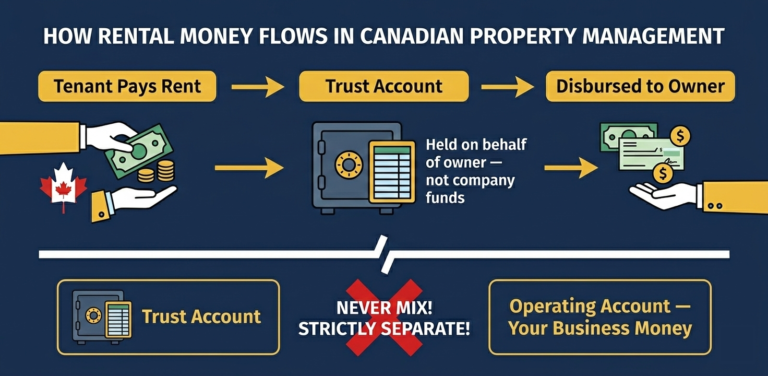
Trust accounting in property management gets referenced constantly and understood clearly far less often. Let’s be precise about what it means.
When a tenant pays rent, that money does not belong to the property management company. It belongs to the property owner. Until it is properly disbursed, it sits in a trust account — a designated holding account for funds that belong to someone else. The same applies to security deposits, reserve funds, and any other money received on behalf of an owner or tenant.
Trust accounting is the complete system for managing those funds. It covers how they are received, how they are recorded, how they are kept separate from your operating money, how they are reconciled, how they are reported, and how they are eventually disbursed. Every step has a right way to do it and a wrong way — and the wrong ways are exactly what regulators look for when they audit.
What trust accounting is not is general bookkeeping. A bookkeeper who has never worked inside a property management operation does not automatically understand trust accounting. A general accounting firm that serves restaurants and retail businesses does not automatically understand trust accounting. The workflows are different. The compliance obligations are different. And the consequences of getting it wrong are different — significantly more serious than a bookkeeping error in most other businesses.
Record retention matters too. Most provinces require trust accounting records to be retained for a minimum of six to seven years. That means your reconciliations, owner ledgers, disbursement records, and bank statements from six years ago need to be accessible and organized — not buried in an email thread or a spreadsheet from a previous employee’s laptop.
2. The Provincial Requirements
This is where Canadian property managers need to pay close attention. The specific requirements vary by province, and the regulator who oversees your operation determines what standard you are held to.
Ontario
In Ontario, trust accounting requirements for property management operations are governed by the Real Estate Council of Ontario (RECO) for brokerages managing rental properties:
- All client funds must be held in a designated trust account — completely separate from operating accounts
- Trust accounts must be reconciled monthly using the three-way reconciliation standard
- Every transaction must be documented with sufficient detail to trace it to a specific property, owner, or tenant
- Trust records must be retained for the required period and produced immediately on RECO request
- Any shortfall in a trust account — regardless of how it occurred — is a serious compliance matter
British Columbia
In BC, the BC Financial Services Authority (BCFSA) — which succeeded RECBC — oversees trust accounting requirements for licensed property managers. The core requirements mirror Ontario in structure: separate trust accounts, monthly reconciliation, detailed records, audit-ready documentation.
One BC-specific note: the province’s privacy legislation, PIPA, intersects with trust accounting records. How you store, handle, and eventually dispose of tenant financial records has a privacy dimension that requires attention alongside the accounting compliance requirements. BC also requires landlords to pay interest on security deposits — the rate for 2025 was 0.95%, reinstated in 2023 after a gap since 2008. (Province of British Columbia)
Alberta
In Alberta, trust accounting requirements for property managers within brokerage structures are overseen by the Real Estate Council of Alberta (RECA). Several Alberta-specific requirements are worth knowing precisely:
Security deposits in Alberta must be placed into interest-bearing trust accounts within two banking days of receipt — and only security deposit monies can be placed in that trust account. (Government of Alberta)
The Alberta security deposit interest rate for 2026 has dropped back to 0%, meaning no interest payment is required on deposits for the 2026 calendar year. In 2025 the rate was 0.5% and in 2024 it was 1.6% — so property managers with tenancies spanning multiple years need to track interest for the periods when the rate was above zero. (Government of Alberta. Security Deposit Interest Rate Calculator. Alberta.ca.)
When a tenancy ends, Alberta landlords have 10 days to return the full deposit with interest or provide a written estimate of deductions, with a final statement and any remaining balance due within 30 days. (Ending a Tenancy- Alberta.ca)
The Alberta government provides an online interest rate calculator for calculating exactly what is owed on deposits spanning multiple calendar years — worth bookmarking.
The Common Standard Across All Three Provinces
| 🏠 The Common Standard Across All Three Provinces Updated 2026 | |||
| Requirement | 🏙 Ontario | 🌊 British Columbia | 🌾 Alberta |
|---|---|---|---|
| Governing Body | RECO | BCFSA | RECA |
| Separate Trust Account | Mandatory | Mandatory | Mandatory |
| Monthly Reconciliation | Mandatory | Mandatory | Mandatory |
| Security Deposit Interest | Not required | 0.95% (2025) | 0% (2026) |
| Deposit Return Timeline | 10 days after tenancy ends | 15 days after tenancy ends | 10 days (estimate) / 30 days (final) |
| Records Retention | 6–7 years minimum | 6–7 years minimum | 6–7 years minimum |
| Sources: Ontario RTA, BC Residential Tenancy Act, Alberta Residential Tenancies Act — verified for 2026 compliance. | |||
3. The Three-Way Reconciliation Standard
This is the part that most general accountants are not trained for — and the part that regulators look at first during an audit.
A three-way reconciliation means three independent numbers must agree with each other at the end of every month:
| ⚖️ Three-Way Reconciliation Standard All three numbers must match exactly — every single month, without exception | |||
| Component | Where It Comes From | What It Represents | Must Equal |
|---|---|---|---|
| Bank Statement Balance | Your actual trust account bank statement | Real cash held in the designated trust account at your financial institution |
✓All three numbers |
| Property Ledger Total | Sum of all property balances in your PM software | What every individual property account shows as its trust balance inside your system |
✓Must match exactly |
| Trust Liability Total | All owner balances + tenant deposits + reserves | Total of all funds held on behalf of others — the amount owed back out to clients |
✓Every single month |
| When these three numbers don't match — something is wrong. Finding it before a regulator does is the entire point. | |||
All three numbers must match. Exactly. Not approximately. Not “close enough.” Exactly.
When they don’t match, something is wrong — and the reconciliation process is how you find it before it becomes a regulatory problem rather than after.
The monthly reconciliation workflow in practice:
Step 1 — Rent collection Tenant payments received and deposited into the trust account. Each payment recorded to the specific tenant ledger within your property management software.
Step 2 — Tenant ledger posting Payments applied against outstanding balances. Arrears updated. Late fees assessed where applicable.
Step 3 — Owner ledger credit Net rent credited to each owner’s ledger after management fee deduction. Expenses charged against the owner’s account.
Step 4 — Accounts payable processing Vendor invoices approved and paid from trust for property-level expenses. Each payment recorded against the relevant property and owner.
Step 5 — Owner distributions Net funds disbursed from trust to owners — after reconciliation is confirmed, not before.
Step 6 — Three-way reconciliation Bank statement balance ✓ Property ledger total ✓ Trust liability total — all three confirmed to match.
Step 7 — Owner statements Monthly statements produced and distributed: income received, expenses paid, management fees, net distribution.
Step 8 — Audit trail preserved All transactions documented with supporting records retained. Six to seven years minimum.
4. Security Deposit Accounting
Security deposits sit inside trust accounting but have their own specific requirements that are worth understanding separately — because getting them wrong creates both compliance exposure and tenant disputes at the end of tenancies.
The core requirement across all three provinces: security deposits must be held in trust, completely separated from operating funds and from rent trust funds in some jurisdictions. They cannot be used for any business purpose while the tenancy is active.
What the accounting workflow needs to track:
- The deposit amount received and the date received
- The property and tenant the deposit is held for
- Any interest that has accrued — particularly relevant in Alberta for tenancies spanning years when the rate was above zero, and in BC where the 2025 rate was 0.95%
- The return date and amount at tenancy end — or the documented basis for any deductions
The Alberta interest calculation specifically: With the 2026 rate at 0%, no new interest accrues this year. But for tenancies that started in 2024 or 2025, interest accrued at 1.6% and 0.5% respectively for those calendar years — and that interest must be calculated and paid at tenancy end. If your records do not track this by-year, you cannot calculate the correct amount owed to departing tenants. The Alberta government’s online calculator handles this — but your records need to contain the data to feed into it.
5. How Software Impacts Trust Compliance
The connection between your property management software and your trust accounting compliance is more direct than most property managers realize. Your software is not just a convenience tool — it is the infrastructure your trust accounting runs on.
What good software does for trust compliance:
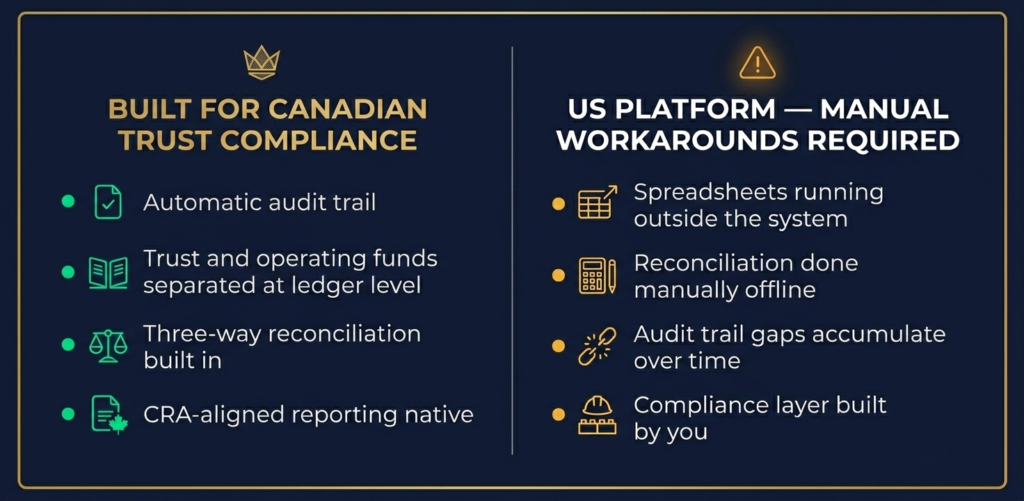
- Maintains a complete, timestamped audit trail of every transaction automatically
- Separates trust and operating funds at the ledger level — not just conceptually
- Produces the three-way reconciliation data needed for monthly compliance automatically
- Tracks owner-level and tenant-level balances accurately in real time
- Generates owner statements and disbursement reports without manual compilation
- Stores records in a retrievable format for the six to seven year retention requirement
Where software gaps create compliance risk:
US-built platforms — Buildium, AppFolio, and others — were not designed around Canadian trust accounting requirements. Property managers using them often find that the trust accounting workflow requires manual workarounds: separate spreadsheets to track what the software doesn’t track natively, manual entries to reconcile between the platform’s reporting and the actual bank account, offline documentation to satisfy what the audit trail doesn’t capture automatically.
Every manual workaround is a point where human error can enter the system. Every spreadsheet running parallel to your property management platform is a version of the records that can diverge from the authoritative source. Over time, these small gaps are exactly where reconciliation problems develop.
The practical implication: Your choice of software is a trust accounting decision, not just an operational one. Platforms built for Canadian compliance — where trust ledger management, three-way reconciliation support, and CRA-aligned reporting are built in rather than bolted on — reduce the compliance burden substantially compared to platforms that require you to build the compliance layer yourself.
6. Where Canadian Property Managers Most Commonly Go Wrong
After talking to property managers across Canada and working with accounting partners who specialize in this space, the same problems surface repeatedly. None of them are exotic. Most of them start small.
Running reconciliations late — or not at all
The single most common trust accounting problem. A busy month, a staff transition, a system issue — and the reconciliation gets pushed. Then pushed again. By the time someone returns to it, the discrepancies have accumulated and cleanup becomes a multi-week project. Regulators do not accept “we got behind” as a mitigating factor.
Commingling funds
Operating expenses paid from the trust account. Management fees taken before reconciliation is complete. A temporary transfer that doesn’t get reversed. Each of these blurs the line between trust and operating funds in ways that regulators treat seriously — regardless of intent.
Owner-level ledger inaccuracy
Rent posted to the wrong property. Management fees calculated incorrectly. Expenses charged to the wrong owner. These errors feel minor when they happen and create significant problems when an owner asks for a detailed accounting and the numbers don’t trace cleanly.
Parallel bookkeeping systems
A spreadsheet running alongside the property management software. A general accounting platform pulling data monthly. Two records that are almost inevitably going to diverge — and a reconciliation process that becomes the work of figuring out which one is right.
Staff transitions without documentation
One person holds the institutional knowledge of how the trust accounting works. They leave. The next person spends weeks reconstructing what entries mean, why certain balances exist, and what the correct current state of the accounts actually is.
Using software not built for Canadian trust accounting
US-built platforms push property managers into workarounds. Every workaround is a failure point.
Trust Accounting Failure Checklist
If any of these are true for your operation right now, the risk is real:
☐ Reconciliation has not been completed for one or more months
☐ Trust account transactions are tracked in a spreadsheet outside the property management software
☐ Owner ledger balances cannot be reconciled to the bank statement within 24 hours
☐ Disbursements have been made before the monthly reconciliation was confirmed
☐ The same person who processes transactions also reconciles the trust account
☐ Software used was not built for Canadian trust accounting requirements
☐ A staff transition has occurred in the last 12 months and documentation was incomplete
☐ Records from more than two years ago are not accessible in organized form
The more boxes that apply, the more urgent the situation. Early cleanup is significantly less disruptive than cleanup that follows a regulator inquiry.
If your reconciliations are behind, it is considerably easier and less costly to fix before an audit than after one.
| ✅ 5-Point Audit Readiness Test Can you produce all five of these within 48 hours if a regulator asked tomorrow? | ||
| Document | What It Shows | Can You Produce It? |
|---|---|---|
| Three-way reconciliation — last 3 months | Bank balance = ledger total = trust liability | ☐ Yes ☐ No |
| Owner ledger — any owner, any month in last 12 | Complete transaction history by owner | ☐ Yes ☐ No |
| Tenant deposit register — current | All deposits held, amounts, dates received | ☐ Yes ☐ No |
| Trust bank statements — last 12 months | Original bank records for the trust account | ☐ Yes ☐ No |
| Disbursement report — last 3 months | All owner distributions with supporting reconciliation | ☐ Yes ☐ No |
| ⚡ If the answer to any of these is No — that is your starting point. Early cleanup is significantly less disruptive than cleanup after a regulator inquiry. | ||
7. The In-House vs Outsourced Accounting Decision
When trust accounting problems surface — or when a portfolio grows to the point where the current setup is not keeping up — most Canadian property managers face the same decision: hire someone in-house, engage an accounting firm, or find specialized support.
The In-House Hire
Bringing accounting in-house feels like the most direct solution. The reality is more complicated. In most Canadian markets, a qualified accounting hire with property management experience typically runs $50,000 to $70,000 annually before benefits, payroll overhead, and onboarding time.
The deeper risk is structural. When one person is responsible for your entire trust accounting function, everything depends on that person. When they go on vacation, your reconciliations wait. When they leave — and eventually they do — the institutional knowledge of your accounts leaves with them. The transition period is when trust accounting problems most commonly develop.
The General Accounting Firm
Outsourcing removes the HR overhead. The gap is specialization. Property management trust accounting requires workflows that general firms encounter rarely: rent roll reconciliation, owner disbursement schedules, arrears tracking, three-way trust reconciliation — all inside the property management software itself, not in a parallel system. When the accounting sits outside the platform, integration lag creates delays and manual adjustments become routine.
What Cleanup Actually Takes
If your books are currently behind, understanding realistic timelines helps with planning:
| 🗓️ What Cleanup Actually Takes — Realistic Timelines Assumes a specialist working directly inside your platform with access to complete records | |||
| Backlog Period | Typical Timeline | Approach | Key Dependency |
|---|---|---|---|
| 1–2 months behind | 2–3 weeks |
Direct reconciliation — catch up and stabilize in a single focused phase Single Phase | Complete bank records and transaction history accessible from the start |
| 3–6 months behind | 4–8 weeks |
Phased approach — reconcile chronologically, resolve discrepancies month by month Two Phases | Software access plus original invoices and receipts available for the period |
| 6–12 months behind | 2–4 months |
Multi-phase stabilization — triage current state first, reconstruct records, then normalize Three Phases | Cooperation from internal team, documentation from prior period where possible |
| 12+ months behind | Multi-phase |
Stabilization first, full reconstruction second, optimization third — each phase assessed individually Full Rebuild | Complete access to all historical records, prior staff documentation where still available |
| 📌 Documentation gaps extend every phase. The sooner cleanup begins, the shorter and less costly the process. | |||
These timelines assume a specialist working inside your platform with access to complete records. Gaps in documentation extend every phase.
Specialized Property Management Accounting Support
The model that consistently produces the most stable outcomes is specialized support built specifically for property management — professionals who understand trust accounting compliance, work directly inside your existing platform, and provide team-based coverage that eliminates key-person dependency.
This typically costs less than a senior internal hire when total employment costs are factored in — and it removes the structural vulnerability of a single point of failure in your accounting function.
8. What to Look For in a Specialized Accounting Partner
They work inside your platform, not alongside it
The right partner works directly inside your property management software — Mi Property Portal, Buildium, Propertyware, or whatever platform you run — keeping all financial data in one place.
They understand provincial trust requirements specifically
Ask them directly: what does a three-way reconciliation look like in practice? How do they handle trust account setup for a new property? What are the specific RECO requirements for Ontario trust accounting? Vague answers are information.
They have team-based structure with backup coverage
A single assigned bookkeeper is a key-person dependency. The right structure includes a dedicated lead with backup accountants familiar with your accounts, so continuity is built in regardless of staffing changes on their side.
They are available during your business hours
Trust accounting issues surface at any time. Your accounting partner needs to be available when you are — not just at month-end.
They are transparent about pricing from the start
Transparent pricing based on actual scope — discussed openly during the initial consultation — is the baseline expectation. Any partner who quotes a flat rate before understanding your operation is either going to underdeliver or reprice once the engagement starts.
9. Questions to Ask Any Accounting Partner Before You Engage
On trust accounting specifically:
- What provincial regulators’ requirements are you familiar with — RECO, RECA, BCFSA?
- Walk me through your monthly three-way reconciliation process in practice
- How do you handle a reconciliation that doesn’t balance on the first attempt?
- What does your Alberta security deposit interest tracking look like for multi-year tenancies?
On platform integration:
- Which property management platforms do you work directly inside?
- Do you work inside our system or extract data into your own tools?
- How do you handle a software migration if we change platforms?
On team structure and continuity:
- Is our account managed by a single bookkeeper or a team with backup coverage?
- What happens if our lead accountant goes on leave or leaves the company?
- How quickly can a new team member get up to speed on our accounts?
On backlog and cleanup:
- If our books are currently behind, what does your cleanup process look like?
- What is a realistic stabilization timeline for our portfolio size?
- How do you document cleanup work for our compliance records?
On pricing:
- How do you structure pricing — hourly, monthly retainer, or per-unit?
- What scope factors drive the monthly cost most significantly?
- Are there additional charges for audit preparation or catch-up work?
The Accounting Partner Available Through North Resource Hub
For Canadian property managers looking for specialized trust accounting support, Global Accounting Pros (GAP) is the accounting partner available through NRH.
GAP works exclusively in Canadian property management accounting. Their model is team-based — dedicated lead accountant plus backup coverage — which eliminates key-person dependency. They work directly inside your existing property management software and operate during Canadian business hours as a true extension of your finance team.
All consultations are free. No contracts required. Pricing discussed transparently based on actual portfolio scope.
Frequently Asked Questions
Trust accounting is mandatory for licensed property managers in most Canadian provinces when they hold client funds — rent, deposits, owner distributions — on behalf of others. RECO governs this in Ontario, BCFSA in BC, and RECA in Alberta.
The core obligation — separate trust accounts, monthly reconciliation, detailed records — is consistent across all three provinces, though the specific regulatory frameworks differ.
Consequences range depending on severity. Minor record-keeping deficiencies typically result in required remediation and follow-up review.
Commingling of funds, reconciliation failures, and missing records can result in financial penalties, mandatory corrective action plans, and in serious cases, licence suspension or revocation.
Regulators treat trust accounting failures seriously because the funds belong to clients, not to the property management company.
Monthly, without exception. The three-way reconciliation standard — bank balance, property ledger total, trust liability total — needs to run every month.
Some property managers with high transaction volumes also run weekly reconciliations as an internal control measure, but monthly is the regulatory minimum across Ontario, BC, and Alberta.
The Alberta security deposit interest rate for 2026 is 0% — meaning no interest payment is required on deposits for the 2026 calendar year.
However, for tenancies that started in 2024 or 2025, interest accrued at 1.6% and 0.5% respectively for those years and must be calculated and paid at tenancy end.
The Alberta government provides an online calculator for multi-year calculations.
A general bookkeeper can handle basic transaction recording, but the specialized workflows — three-way reconciliation, owner disbursement schedules, rent roll alignment, provincial compliance requirements — typically require specific property management accounting experience.
The consequences of getting it wrong are more serious than standard bookkeeping errors in most business contexts.
It depends on how far behind the books are. A one to two month backlog typically takes two to three weeks to stabilize with specialized support.
Three to six months takes four to eight weeks. Twelve months or more requires a multi-phase approach — stabilization first, then optimization.
Early intervention is significantly less disruptive and less costly than cleanup following a regulator inquiry.
An operating account holds your business's own money — management fees, your own business expenses.
A trust account holds money that belongs to others — rent collected on behalf of owners, security deposits held on behalf of tenants. These must never be commingled.
Money in a trust account cannot be used for business expenses or payroll under any circumstances.
Related Resources:
- The Complete 2026 Guide for Canadian Property Managers — see Section 4 for the trust accounting overview that links to this guide
- Accounting & Finance Partners for Canadian Property Managers
- Global Accounting Pros — Specialized Property Management Accounting
Pingback: Tenant Screening Canada: The 2026 Legal Guide for PMs