
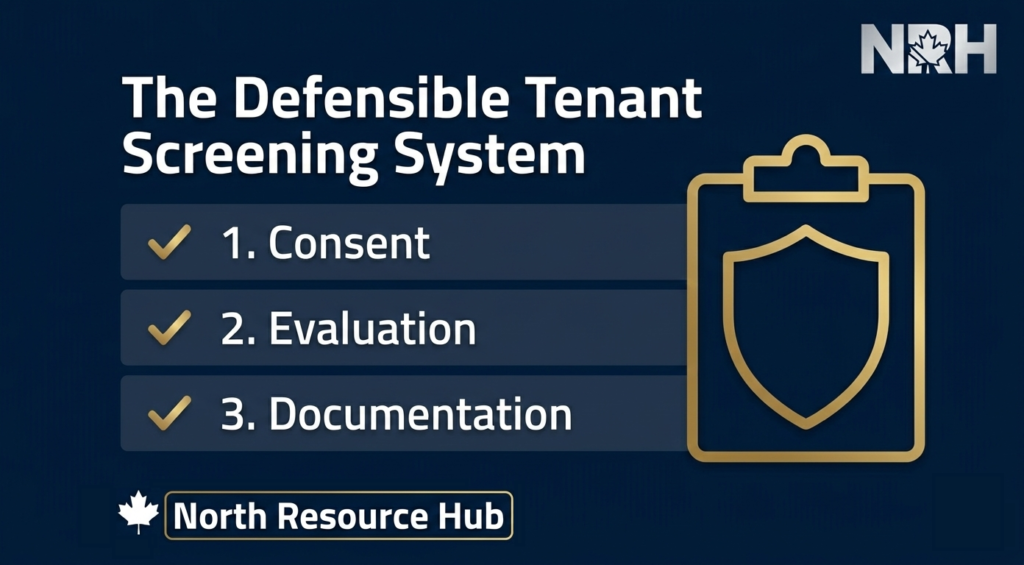
Legal Disclaimer: This guide is for informational purposes only and does not constitute legal advice. Tenant screening in Canada involves federal and provincial privacy legislation, human rights codes, and regulatory requirements that vary significantly by province. Always consult qualified legal counsel for matters specific to your operations and jurisdiction.
Picture this. A tenant application came in on a Tuesday. By Wednesday afternoon a decision was made, a short email sent, and the file closed. Routine. One of dozens that month.
Three months later, a letter arrives from a provincial Human Rights Tribunal. A complaint has been filed. You are asked to produce your written screening criteria, your consent documentation, your evaluation notes, and your contemporaneous reasoning for the rejection.
What do you hand over?
For many property managers, the honest answer is: not much. A judgment call that made sense at the time. A brief email that says “we went with another applicant.” A credit check that was pulled before a consent form was signed. Notes that were never written down. A mental process that was reasonable in the moment and now exists nowhere on paper.
The distance between the decision that was made and the documentation that would support it — that is where tenant screening risk quietly lives for Canadian property managers in 2026. And it has nothing to do with whether the right call was made. It has everything to do with whether the process surrounding that call was built to hold up when examined.
This is not a guide about how to spot red flags or avoid problem tenants. There are plenty of those, most of them written for the US market. This is something more specific: a framework for building a tenant screening system that is consistent, legally compliant with Canadian law, and defensible if it is ever tested — by a regulator, a privacy commissioner, or a human rights tribunal.
The difference between a good screening decision and a defensible screening process matters more than most property managers realize. This guide builds both.
What This Guide Covers
- Why tenant screening carries more legal weight than most workflows reflect
- The legal framework—PIPEDA, CPPA, and provincial privacy law
- What you can and cannot collect on a rental application
- The consent workflow—what must happen before any check runs
- Credit checks—what they actually show and which services work in Canada
- Background and eviction history checks in Canada
- Human rights obligations—decisions that need to be documented to be defensible
- Social media screening—what is permissible and what creates exposure
- AI-powered screening tools—opportunity and accountability
- Rental fraud detection in 2026
- The 6-part defensible screening framework
- Tools and partners vetted for Canadian compliance
- Frequently asked questions
1. Why Tenant Screening Carries More Legal Weight Than Most Workflows Reflect
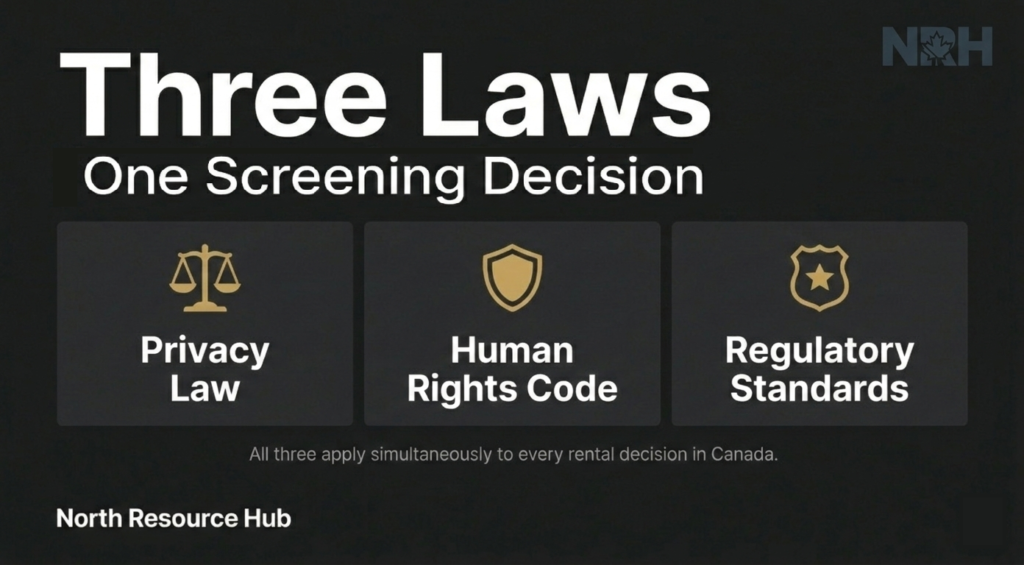
Tenant screening sits at the intersection of three bodies of Canadian law that operate simultaneously and independently of each other. Federal and provincial privacy legislation governs how personal information is collected, used, stored, and eventually destroyed. Provincial human rights codes govern which factors may legally influence a rental decision. And regulatory standards tied to licensing — in provinces like Ontario and Alberta — layer professional obligations on top of what either privacy or human rights law requires on their own.
Most property managers have a solid working knowledge of the human rights piece, since it tends to be the most visible. Where property managers sometimes discover gaps — often only after something has already gone sideways — is in the privacy compliance layer and the documentation standard. These are less talked about, less intuitive, and can catch even experienced operators off guard.
Documentation is a good example of this. A rejection made on entirely legitimate grounds can still be difficult to support if the evaluation process was not recorded at the time the decision happened. It is not that the call was wrong. It is that nothing contemporaneous exists to show what information was considered, how it was weighed, and why it led to the outcome it did. Notes written weeks later are not the same as notes written on the day, and adjudicators treat them accordingly.
Consent is another area worth understanding clearly. Running a credit check before documented written consent is obtained from the applicant is not a grey area under the Personal Information Protection and Electronic Documents Act (PIPEDA). It does not become acceptable because the credit report came back clean, or because the applicant seemed agreeable, or because it has been done that way for years without issue. The requirement is in the sequence — consent first, check second — and the sequence matters regardless of the outcome.
None of this is intended as a critique of current practice. Most property managers doing this work every day are operating in good faith. The point is simply that the standard used to evaluate a challenged screening decision is more detailed than the standard most screening processes are currently built to meet. Closing that gap is what this guide is for.
2. The Legal Framework — PIPEDA, CPPA, and Provincial Privacy Law
The privacy law landscape governing tenant screening in Canada is both established and actively evolving. Understanding what applies right now — and what is coming — shapes how a screening process should be built today.
PIPEDA — The Current Federal Standard
The Personal Information Protection and Electronic Documents Act governs the collection, use, and disclosure of personal information in commercial activity across Canada, except in provinces that have enacted substantially similar legislation.
For property managers, this means every piece of personal information collected from a rental applicant — name, address history, income, employment, references — is subject to PIPEDA’s ten fair information principles.
Four of those principles are the most directly relevant to screening. Consent requires meaningful, specific authorization before personal information is collected. Purpose limitation means information collected to evaluate a rental application cannot be repurposed for something else.
Retention means personal information should be kept only as long as necessary to fulfill the purpose it was collected for, then destroyed securely. And safeguards requires that all personal information be protected against unauthorized access, disclosure, or loss.
PIPEDA does not prohibit screening. It sets the standards under which screening must be conducted to be lawful.
The CPPA — What Is Coming and What to Do
Bill C-27, which introduces the Consumer Privacy Protection Act as a replacement for PIPEDA, had not yet received Royal Assent as of early 2026, though its passage in some form is widely anticipated. The CPPA would strengthen consent requirements, introduce expanded individual rights over personal data including a right to deletion, and create formal organizational accountability obligations including privacy management programs.
The practical takeaway for property managers: the steps required to comply with CPPA are largely the same as the steps required to comply with PIPEDA, executed more rigorously. A properly built PIPEDA-compliant screening process — documented consent, clear retention schedules, secure storage — will be substantially ahead of where CPPA will require organizations to be.
The Office of the Privacy Commissioner of Canada is the appropriate source to track implementation timelines as they develop.
Provincial Privacy Laws
| Province | Applicable Law | Key Difference for Property Managers |
|---|---|---|
| British Columbia | BC PIPA (Personal Information Protection Act) | Substantially similar to PIPEDA. The BC Information and Privacy Commissioner has published specific guidance on tenant screening and social media checks. Consent is sometimes interpreted more strictly in practice. |
| Alberta | Alberta PIPA (Personal Information Protection Act) | Substantially similar to PIPEDA. RECA-regulated brokerages carry additional accountability obligations under RECA's professional standards, layered on top of Alberta PIPA. |
| Ontario | PIPEDA (federal) + Ontario Human Rights Code | No substantially similar provincial privacy law — PIPEDA applies directly. The Ontario Human Rights Code creates significant obligations around rental decisions. RECO-regulated brokerages carry additional professional standards. |
| All Other Provinces | PIPEDA (federal) | Federal PIPEDA applies directly. Provincial human rights codes apply in every province regardless of which privacy law governs the data collection side. |
| Privacy law governs how data is collected and handled. Human rights legislation governs which factors may influence a rental decision. Both operate simultaneously and independently. | ||
If there is any uncertainty about whether your current application form and consent process meets the requirements of the law applicable in your province, that is worth working through before the next application cycle.NRH’s vetted compliance partnerscan review your current workflow and identify what specifically needs attention — at no cost for an initial conversation.
3. What You Can and Cannot Collect on a Rental Application
The rental application is the first place where privacy compliance is either built in or skipped. Under PIPEDA and its provincial equivalents, property managers may only collect personal information that is reasonably necessary to evaluate a rental application. In theory, that sounds straightforward. In practice, several items that appear regularly on Canadian rental applications are worth a second look.
| ✅ Generally Permissible to Collect | ❌ Creates Privacy or Human Rights Risk |
|---|---|
| Full legal name and contact information | Social Insurance Number — not required to evaluate tenancy suitability |
| Current and previous addresses (past 3–5 years) | Number or ages of children in the household |
| Employment status, employer name, income verification | Immigration status or citizenship |
| Landlord references — current and prior | Social media handles or requests to view profiles |
| Written consent to credit check — with proper disclosure | Religion, marital status, sexual orientation — any protected ground under the applicable human rights code |
| Government-issued ID to verify identity — with appropriate limitations | Requiring photo ID as a condition in Ontario — receipt of public assistance is a protected ground under the Ontario Human Rights Code |
| Number of intended adult occupants | Requests to access social media accounts or digital profiles |
| Reflects general guidance under PIPEDA and provincial human rights codes as of 2026. Province-specific rules apply. Consult qualified legal counsel to review your specific application form. | |
The Social Insurance Number gets its own mention here because it appears on rental applications in Canada more often than it should. Both Equifax Canada and TransUnion Canada can run a credit check using a name, date of birth, and address — a SIN is not part of that process. Requesting it on a rental application collects a high-sensitivity identifier that goes beyond what is needed to evaluate tenancy suitability. Several provincial privacy commissioners have specifically flagged this in published guidance.
Income is a more layered question. Asking about income is generally fine. Applying an income threshold in a rigid way — without any flexibility for how income is structured, supplemented, or sourced — can become a problem in provinces where the source of income is a protected ground. That specific dynamic is addressed in Section 7.
4. The Consent Workflow — What Must Happen Before Any Check Runs
Under PIPEDA and its provincial equivalents, consent for collecting personal information must be meaningful. The person must genuinely understand what is being collected, why, how it will be used, who may access it, and how long it will be kept.
A checkbox tucked at the bottom of a multi-page application, next to a paragraph of legal language that nobody reads carefully in the moment of filling out a form, is unlikely to meet that standard consistently.
The sequence below represents the minimum defensible consent workflow for Canadian property management operations:
- Provide a written privacy notice before the application is submitted. This notice should clearly state what personal information will be collected, the purpose (evaluating rental suitability), who may access it – property manager, owner, any credit bureau or screening service used – how long it will be retained, and how to reach you with privacy-related questions.
- Obtain separate written consent for each type of check. Consent to run a credit check is a different authorization than consent to a criminal background check or an employment verification call. Bundling them into a single general clause has been raised by privacy commissioners as insufficient to meet the meaningful consent standard under PIPEDA.
- Confirm the applicant’s identity before any check is initiated. This serves two purposes: it is a privacy requirement — you need to confirm the check is being run on the correct individual—and it is a basic fraud prevention step.
- Document when consent was obtained, in what form, and by whom. Electronic intake systems should log a timestamp and the version of the privacy notice the applicant saw. Paper-based processes should retain the signed form.
- Do not run any checks before consent is confirmed in writing. This step gets skipped most often when there is time pressure – a unit that needs to be filled or a shortlist that is moving quickly. But initiating a credit check before written consent is documented is a privacy law issue, regardless of how the report turns out. Sequence matters.
- Inform applicants of their rights under applicable privacy law. Under PIPEDA, individuals have the right to access personal information you hold about them and to challenge its accuracy. A brief statement of these rights belongs in the application package.
One practical note: consent can be withdrawn at any point. If an applicant withdraws consent partway through evaluation, the obligation is to stop collecting and using their information from that point forward. Treating consent confirmation as its own discrete step at the start of the process — rather than an embedded formality — makes managing withdrawal situations operationally cleaner.
If you are not certain whether your current consent form holds up under federal privacy standards, that is worth clarifying proactively. NRH’s vetted compliance partners can review your application intake process and identify what specifically needs attention.
5. Credit Checks — What They Show, What They Don't, and Which
Services Work in Canada
A credit check is the most commonly used screening tool in Canadian property management — and one of the most commonly misread. Being precise about what a Canadian credit report actually contains, versus what property managers sometimes assume it contains, matters both for using it effectively and for avoiding decisions that look reasonable on the surface but are built on incomplete data.
What a Canadian credit report actually shows
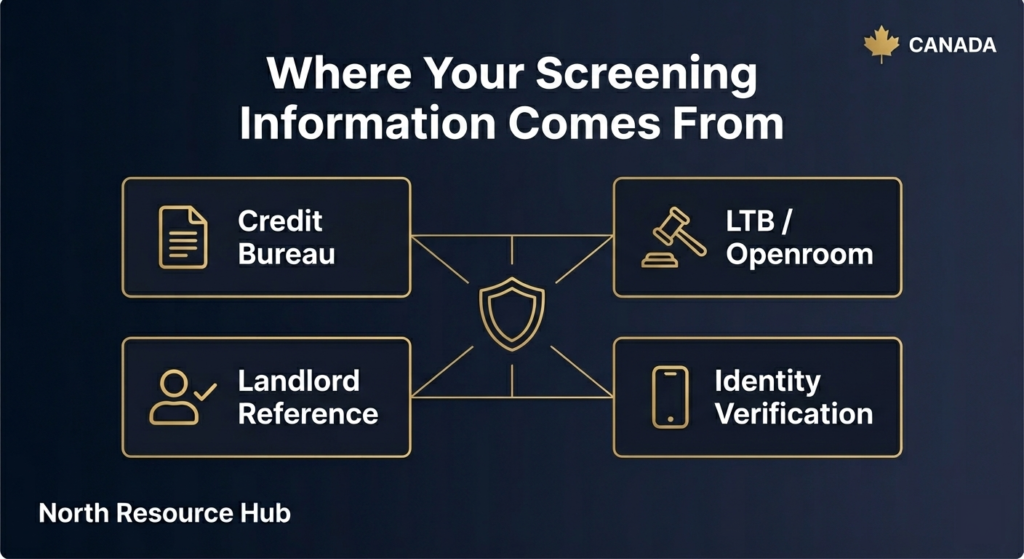
A report from Equifax Canada or TransUnion Canada includes payment history on credit accounts — credit cards, loans, and lines of credit; outstanding balances and credit utilisation; account types and the age of those accounts; public records such as bankruptcies and consumer proposals; and a log of recent inquiries from other lenders.
What it does not include is income, employment history, or rental payment history — unless that rental history has been specifically reported to a bureau through a rent reporting service like FrontLobby.
That gap matters. A thin credit file — limited accounts, a short history, and a lower score — may reflect someone who is relatively new to Canada, a younger adult just building credit, or a person who has simply managed their finances outside the credit system.
It does not, on its own, say anything reliable about how that person will behave as a tenant. Treating credit score as the primary evaluation filter tends to be both less accurate than it feels and more legally exposed than property managers often realize.
Screening services for Canadian property managers
| Service | What It Provides | Canadian Bureau | Key Notes |
|---|---|---|---|
| Equifax Canada | Full credit report and score | Yes | Direct bureau access; requires PM account setup |
| TransUnion Canada | Full credit report and score | Yes | Direct bureau access; widely used in Canadian property management |
| SingleKey | Credit + identity + income verification + optional rent guarantee | Yes | Canadian-built; applicant-initiated report model; PIPEDA-aligned workflow |
| FrontLobby | Credit check + rental payment history reporting to Equifax | Yes | Bidirectional tool — also helps current tenants build rental credit history |
| Certn | Credit + background + identity + international verification | Yes | BC-based; strong compliance documentation; well-suited to markets with international applicants |
| US-based platforms | Credit + background checks using US bureau data | No | Pull from US bureaus only. Canadian credit history not captured. PIPEDA compliance not guaranteed. |
| Service offerings change. Verify current capabilities directly with each provider before adopting any tool for your portfolio. | |||
The US platform situation deserves a specific callout. Several widely used property management software platforms were built for the US market and integrate screening with US credit bureaus.
When a Canadian property manager runs a credit check through one of those integrations, the data is pulled from a bureau that may have no record of that applicant’s Canadian credit history at all. The report comes back thin or empty — not because the applicant has poor credit, but because their file is at Equifax Canada or TransUnion Canada, not in the US system. The result is both an accuracy problem and a compliance concern.
Several of the Canadian services in the table are vetted partners in the NRH network.Book a free consultation to identify the right fit for your province, portfolio size, and software environment.
6. Background and Eviction History Checks in Canada
Background checking in Canada is more constrained and more fragmented than in the United States. Knowing what tools actually exist — and what their limitations are — helps property managers use them accurately rather than making decisions based on incomplete or misread results.
Eviction history
There is no national centralized eviction database in Canada. In Ontario, decisions from the Landlord and Tenant Board are publicly accessible through the LTB’s online search and through Openroom.ca, a third-party platform that indexes LTB decisions and makes them searchable by name.
For Ontario-based property managers this is a useful resource — it allows you to determine whether an applicant has a documented history of LTB proceedings related to non-payment, property damage, or tenant conduct.
In BC and Alberta, no comparable centralized resource exists. Landlord reference checks carry more weight in those provinces as a result. A thorough reference process means a live phone conversation with the prior landlord — not a written letter the applicant provided.
Criminal background checks
Criminal background checks are available through services including Triton Canada. The important compliance point is that a criminal record cannot be used as an automatic disqualifier under most Canadian provincial human rights codes. Any consideration of criminal history must be contextual — relevant to the specific tenancy, proportionate to the nature of the record, and not applied as a blanket policy across all applicants with any history at all.
Blanket criminal background policies have been successfully challenged at provincial human rights tribunals. The defensible approach is to document how criminal background factors into your evaluation criteria, what types of records are relevant to residential tenancy specifically, and how individual circumstances are considered. That documented framework is what makes the decision supportable — not the existence of the check.
7. Human Rights Obligations — Decisions That Need to Be Documented to Be Defensible
Every province in Canada has human rights legislation prohibiting discrimination in housing on protected grounds. Collectively across provincial codes those grounds include: race, ancestry, place of origin, colour, ethnic origin, citizenship, creed or religion, sex, sexual orientation, gender identity and expression, age, marital status, family status, disability, and — in Ontario specifically — the receipt of public assistance as a source of income.
The obligation here has two parts that are worth keeping distinct. The first is that rental decisions must be based on legitimate rental criteria, not on any of those protected grounds. The second is that property managers must be in a position to demonstrate that if challenged. Both matter — but the second is the one that tends to be underprepared.
The income-to-rent ratio — where it gets nuanced
Using an income threshold as a screening criterion is a standard and generally permissible practice. Where it becomes more complicated is when it is applied rigidly, without flexibility for how an applicant’s financial capacity is structured, and in a way that has the practical effect of excluding applicants based on their source of income rather than their actual ability to pay.
In Ontario, the Ontario Human Rights Code explicitly includes receipt of public assistance as a protected ground in housing. A hard income-to-rent ratio applied as an automatic cutoff — without any consideration of guarantors, co-signers, rental history, or other indicators of capacity — has been found in some tribunal decisions to have a discriminatory effect on applicants receiving disability income or social assistance, even when no discriminatory intent existed.
The defensible standard is to apply income criteria consistently, allow applicants to demonstrate financial capacity through the full picture of their situation, and document how that assessment was made. The question being evaluated should genuinely be capacity to pay — not a proxy for something else.
What rejection documentation actually needs to include
Rejection decisions communicated informally — a phone call, a brief email, silence — leave very little to work with if the decision is later challenged. The documentation standard for a defensible rejection process has four elements, all recorded at the time the decision is made:
- Written evaluation criteria are established before any applications are reviewed. Pre-established criteria are what allow you to demonstrate that every applicant was evaluated against the same standard.
- Contemporaneous notes for each application evaluated—what information was reviewed, how the criteria were applied, and what the outcome was and why. Notes written after a complaint is filed carry a different weight than notes written at the time.
- A written rejection communication identifying the legitimate rental criterion that was not met—without referencing any protected characteristic, even in passing.
- Retention of those notes for a period consistent with the human rights limitation period in your province—typically one to two years from the date of the decision.
It is worth saying plainly: the purpose of this documentation is not to build a legal wall around decisions. It is simply the natural result of a process that is genuinely based on consistent, legitimate rental criteria.
When those criteria are written down and applied the same way every time, the documentation exists because the process was sound, not because anyone anticipated being challenged.
8. Social Media Screening — What Is Permissible and What Creates Exposure
Searching for a rental applicant on social media before making a decision is something many property managers do. It is also an area where it is worth understanding the specific legal dynamics before the practice becomes part of a complaint.
The BC Information and Privacy Commissioner has addressed social media screening in the residential tenancy context and raised concerns under BC PIPA about conducting unsolicited searches — reviewing an applicant’s public online presence without their knowledge or consent as part of the rental evaluation process.
Beyond the privacy concern, the more significant risk is what a social media search may surface. Looking up an applicant on LinkedIn, Facebook, or Instagram may expose information about their religion, family composition, disability, ethnic background, or other protected characteristics.
Even when that information genuinely plays no role in the decision, having accessed it creates a constructive knowledge problem: it becomes difficult to demonstrate credibly that information you encountered did not, in any way, factor into the assessment.
For property managers who include social media as part of screening, a reasonable risk-reduction framework looks like this:
- Disclose in the application privacy notice that social media may be reviewed as part of the process, and obtain explicit consent for that specific purpose
- Limit the scope strictly to identity confirmation and professional context—not personal profiles, posts, or photographs
- Document that any protected characteristics encountered did not form part of the evaluation
- Apply the practice with complete consistency—reviewing some applicants and not others creates its own exposure
Many property management companies find it operationally cleaner to establish a written policy that social media profiles are not reviewed during tenant screening and to apply that uniformly. That approach eliminates the constructive knowledge risk entirely and is straightforward to document and defend.
9. AI-Powered Screening Tools — Opportunity and Accountability
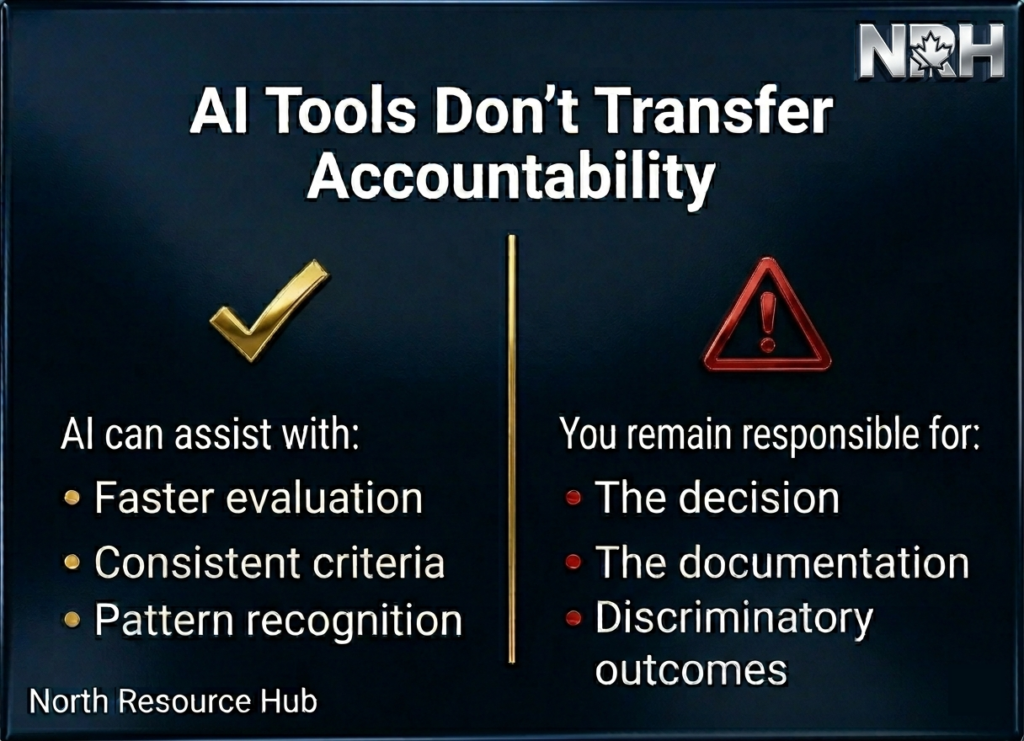
AI-assisted screening tools have become a more visible part of the Canadian property management landscape in 2026. The operational case is real — faster evaluation across larger application volumes, more consistent application of defined criteria, pattern recognition across data points that a person reviewing dozens of files in a week may not reliably connect.
For property managers managing large portfolios or high-turnover properties, these tools represent a genuine efficiency gain. The compliance considerations in the Canadian context are just as real, and they operate at two levels.
Algorithmic outcomes and human rights
Canadian human rights legislation does not create an exception for decisions made through algorithmic or AI-assisted systems.
If a screening tool produces outcomes that disproportionately exclude applicants on the basis of a protected characteristic — even with no discriminatory intent anywhere in the process — those outcomes are still discriminatory under the human rights codes of every Canadian province. The intent of the algorithm is not the relevant question. The effect of the outcome is.
This creates a specific due diligence obligation before adopting any AI screening product for Canadian operations. You need to understand how the model was trained, what data inputs it uses, whether it has been independently audited for bias, and whether the vendor can provide documentation of that audit in a form that means something in the Canadian human rights context.
A vendor who cannot clearly answer those questions is one whose product cannot be responsibly deployed in a Canadian rental market.
The accountability that stays with the property manager
This is the point that matters most: even when an AI tool produces a score, a recommendation, or a ranked result, the property manager is still the decision-maker. That accountability does not transfer to the algorithm or the vendor. The PM is responsible — for the decision itself, for the documentation that supports it, and for any discriminatory outcome it produces.
AI tools augment the screening process. They do not replace the property manager’s accountability for it. Whatever a tool generates, the evaluation workflow still needs human review, contemporaneous documentation of the criteria applied, and a defensible rejection record if the application is declined.
Before integrating any AI screening product into your Canadian workflow, it is worth having the tool’s compliance approach assessed in the context of the provinces you operate in. NRH’s vetted compliance partners can support that assessment.
10. Rental Fraud Detection in 2026
Application fraud—falsified income documentation, manipulated bank statements, and misrepresented identity—has become a routine operational concern across Canadian rental markets.
The combination of sustained market pressure and widely available document editing tools has shifted this from an occasional exception to something property managers encounter often enough that it warrants a systematic response, not just heightened vigilance.
Income documentation red flags
The most common form is falsified pay stubs and altered bank statements. A few indicators worth building into your review process:
- Inconsistent fonts or alignment within a document. PDF-edited files frequently show subtle spacing or typeface irregularities that differ from the original source formatting.
- Deposits in exactly round numbers. Legitimate net payroll deposits — after tax deductions, CPP contributions, and benefit premiums — are almost never round numbers.
- Stated income that does not match the position. Comparing claimed earnings against publicly available salary ranges for the stated role and industry is a fast, useful check.
- Bank statement formatting that differs from the institution’s standard.Cross-referencing against a legitimate sample from the same bank will surface layout differences that indicate tampering.
Income verification through open banking
Open banking-based income verification services allow applicants to share read-only access to their bank transaction data directly through their banking app. Flinks and Inverite are Canadian providers in this space.
The data comes from the financial institution itself rather than from a document the applicant prepared — a source that is significantly harder to falsify. For applications where documentation raises questions, adding an open banking verification step provides a level of confidence that document review alone cannot.
Identity verification
Identity fraud in rental applications — applying under a false name to obscure a prior eviction or criminal history — can be addressed through digital identity verification services that cross-reference government-issued ID against authoritative databases.
Certn and other Canadian screening providers include this in their service packages. In high-demand markets where volume creates pressure to move quickly, identity verification is a step that consistently earns its place in the workflow.
11. The 6-Part Defensible Screening Framework
Everything in this guide builds toward one operational objective: a tenant screening process that produces sound rental decisions and can be clearly explained — to a regulator, a human rights tribunal, or a privacy commissioner — if it is ever scrutinized.
The six components below are not enhancements for larger or more sophisticated operations. They are the foundation of any screening process that is genuinely built to last.
| # | Component | What It Requires | Retention Period |
|---|---|---|---|
| 1 | Standardized Application Intake | The same form for every applicant. Collects only permissible information. Reviewed annually against current guidance from the OPC and applicable provincial regulator. | 1 year minimum after decision — unsuccessful applicants |
| 2 | Explicit Written Consent Protocol | Separate written consent for each check type. Privacy notice provided before submission. Consent timestamp documented in retrievable form. | Duration of tenancy plus 2 years minimum |
| 3 | Defined Evaluation Criteria | Written criteria established before any applications are reviewed. Objective, rental-relevant, applied consistently to every applicant. Documented and reviewed for each rental period. | Permanent — criteria for each rental period retained |
| 4 | Documentation of Decision Logic | Contemporaneous notes for each application — what information was reviewed, how criteria were applied, what the outcome was and why. Written at the time of the decision, not reconstructed afterward. | 1–2 years post-decision depending on province |
| 5 | Consistent Rejection Communication | Written communication identifying the legitimate rental criterion not met. No reference to protected characteristics. Applied consistently to every declined applicant. | 1–2 years minimum — aligned with human rights limitation period |
| 6 | Secure Retention and Destruction Policy | Application materials stored securely — encrypted if digital, locked if physical. Retained only as long as the documented schedule requires. Destroyed securely once the retention period expires. | Per schedule above — destroy promptly at expiry |
| Retention periods reflect general guidance. Consult qualified legal counsel for province-specific requirements and the limitation periods applicable to your operations. | |||
Getting this framework in place from scratch takes real time — the kind most property managers do not have spare while managing an active portfolio. NRH’s vetted compliance partners can audit your current screening process against these six components, identify what specifically needs attention, and support implementation. No cost for the initial conversation.

12. Tools and Partners Vetted for Canadian Compliance
A compliant Canadian tenant screening workflow needs tools across five operational categories. What follows is a framework for evaluating each one — focused on what matters for Canadian compliance, not just general functionality.
Consent management. Your application intake — paper or digital — needs to capture, timestamp, and store consent documentation in a retrievable format. If your property management software handles intake, verify that its consent workflow meets PIPEDA’s meaningful consent standard. If it does not, a supplementary step is required to fill that gap.
Credit and identity verification. Use a service that pulls from Equifax Canada or TransUnion Canada. Confirm the service’s data handling practices align with PIPEDA. Applicant-initiated report models are worth considering — they put the applicant in direct contact with the screening service for consent, which streamlines your own consent workflow.
Background and eviction checks. Understand what a specific service actually provides in your province before relying on it. In Ontario, Openroom.ca provides LTB decision search. For criminal background checks nationally, several Canadian providers are available. Verify that any service you use has a data handling agreement consistent with Canadian privacy law.
Fraud detection. For applicants where income documentation cannot be independently verified through a direct employer call, open banking-based income verification should be part of the standard workflow. The data comes from the financial institution itself — not a document the applicant provided — which provides a qualitatively higher level of confidence.
Document storage and retention. Application materials containing personal information must be stored securely and destroyed on schedule. Confirm that your storage system — whether within your PM software or separate — meets PIPEDA’s safeguard requirements for the sensitivity of what is being held.
Every partner in the North Resource Hub network has been evaluated for Canadian market experience, compliance awareness, and service quality. Property managers can connect with vetted screening, compliance, and operational partners through NRH with no contracts, no lock-ins, and no obligation for the initial consultation.
The System Is What Survives
The property managers who have the least friction with screening-related complaints are not necessarily making better individual calls than their peers. The difference, almost always, comes down to the process surrounding the decision — the documentation, the consistency, the written criteria established before a single application came in.
A well-made decision is good. A well-made decision inside a defensible system is the one you can stand behind when it is examined.
North Resource Hub exists to make that system practical for Canadian property managers, through vetted partners across trust accounting, tenant screening, software selection, and operational compliance who understand the Canadian regulatory environment and what it actually demands. Explore the NRH partner network—or read our trust accounting compliance guide for the financial side of Canadian property management operations.
Frequently Asked Questions
Yes. Tenant screening is legal and standard practice for property managers across Canada.
Federal and provincial privacy law governs how the process is conducted — what information can be collected, how consent must be obtained, and how long records may be kept.
Provincial human rights codes govern which factors may influence rental decisions.
Operating within that framework, tenant screening is both legally permissible and a professional responsibility.
It is not prohibited outright, but it carries specific legal considerations.
The BC Information and Privacy Commissioner has raised concerns about unsolicited social media searches under BC PIPA. The more significant concern across all provinces is constructive knowledge — accessing a social media profile may surface protected characteristics, and having that information makes it difficult to demonstrate that it played no role in the decision.
The cleanest approach operationally is a written policy that social media is not reviewed during screening, applied consistently to every applicant
Yes. Under PIPEDA, consent must be meaningful and specific to the purpose for which personal information is being collected. Initiating a credit check before written consent is documented is a privacy law issue regardless of what the report shows.
Consent should be a distinct step before any check runs, and the documentation — including the timing and the privacy notice presented — should be retained.
There is no universal threshold — individual property managers set their own criteria, and those criteria need to be applied consistently.
Using credit score as the sole evaluation criterion tends to be both less accurate than it appears and more legally exposed than many operators realize, particularly in its potential effect on applicants who are under-represented in the Canadian credit bureau system.
Credit score is most useful as one element within a broader evaluation, not as a standalone filter.
Income-based criteria are generally permissible when applied consistently and as a genuine measure of capacity to pay.
Where they become legally complicated is when they have the practical effect of excluding applicants based on their source of income rather than their actual financial capacity — particularly in Ontario, where receipt of public assistance is a protected ground under the Ontario Human Rights Code.
The defensible approach is to apply the threshold consistently, allow applicants to demonstrate capacity through their full financial picture, and document how that was evaluated.
Retention obligations depend on the record type and applicable law.
As a general framework: consent documentation should be kept for the duration of the tenancy plus a minimum of two years.
Evaluation notes and rejection documentation for unsuccessful applicants should be retained for one to two years from the decision date, aligned with the human rights complaint limitation period in your province.
Personal information should be destroyed securely once the applicable retention period expires. Consult qualified legal counsel for province-specific guidance.
The property manager remains accountable. Canadian human rights legislation does not create an exemption for decisions made through algorithmic systems — if the outcome is discriminatory, the liability rests with the party who made and acted on the decision, regardless of what tool informed it.
Before adopting any AI screening product for Canadian operations, it is worth understanding how the model was trained, whether it has been audited for bias, and what compliance documentation the vendor can provide in the Canadian context.
The Consumer Privacy Protection Act is the proposed federal replacement for PIPEDA, introduced under Bill C-27. It would strengthen consent requirements, introduce a right to data deletion, and create formal organizational accountability obligations including privacy management programs.
As of early 2026 it had not yet received Royal Assent. Property managers who build a rigorous PIPEDA-compliant screening process now — documented consent, clear retention schedules, secure storage — will already be substantially aligned with what CPPA will require when it comes into force.
This guide is for informational purposes only and does not constitute legal advice. Tenant screening in Canada involves federal and provincial privacy legislation, human rights codes, and regulatory requirements that vary by province and by the structure of your operation.
Always consult qualified legal counsel for guidance specific to your jurisdiction and circumstances.
Related Resources:
- The Complete 2026 Guide for Canadian Property Managers — the full operational and regulatory landscape for Canadian PMs
- Trust Accounting for Canadian Property Managers: What It Actually Requires in 2026 — the financial compliance guide that sits alongside this one