
[This guide is researched and published by the North Resource Hub editorial team. Partner recommendations reflect NRH’s vetted ecosystem. All assessments are independent.]
Here’s something that probably doesn’t surprise you: most of the property management content online was written for an American audience.
The software comparisons. The compliance guides. The “top 10 tools” listicles. Almost all of it defaults to US regulations, US banking infrastructure, US lease law. Canadian property managers reading those resources are essentially trying to navigate with the wrong map.
This guide exists because that gap is real — and getting more costly to ignore. Between provincial tenancy legislation, trust accounting compliance, federal and provincial privacy law, and a vendor landscape that’s fragmented by region, managing properties in Canada in 2026 is a fundamentally different operational challenge than managing them south of the border. A different challenge that deserves its own resource.
Whether you’re managing 5 units or 500, everything in this guide is built for the Canadian landscape specifically.
What This Guide Covers
- The Canadian property management industry in 2026 — by the numbers
- Provincial regulations every Canadian property manager must know
- Property management software in Canada
- Trust accounting compliance — what property managers must understand
- Tenant screening under PIPEDA, the CPPA, and provincial privacy law
- Building reliable vendor networks across Canadian markets
- The end-to-end Canadian property management tech stack
- A centralized resource built for Canadian property managers
- Questions to ask before choosing any partner
- The future of property management in Canada
1. The Canadian Property Management Industry in 2026 — By the Numbers
Let’s start with the scale of what we’re talking about.
Approximately 35,000 property management businesses operate across Canada, and the industry reached $9.8 billion in annual revenue through the end of 2025, according to IBISWorld. Growth has been measured — a 0.3% CAGR over the period, with a 0.9% climb in 2025 specifically.
That’s not headline-grabbing expansion, but it reflects something more durable: sustained demand for residential rental management, which remains the largest segment of the industry, keeps the sector moving forward even when broader economic conditions create headwinds.
The software side of this industry is moving faster than most people expect. Globally, the property management software market is on track to hit USD 42.89 billion by 2030 — a 10% CAGR, according to Fortune Business Insights. Canada is moving in the same direction.
The domestic market is expected to approach $1.04 billion USD by 2030, which tells you something: cloud-based operations aren’t a competitive edge anymore for Canadian property managers. They’re just the cost of running a serious operation.
The rental market itself shifted meaningfully in 2025. Canada’s national vacancy rate climbed from 2.2% to 3.1%, driven by record levels of new purpose-built rental supply hitting the market while population growth slowed down, according to CMHC’s 2025 Rental Market Report. That’s a notable shift in a relatively short period.
What does a rising vacancy rate actually mean for property managers day to day? It means the work doesn’t get easier — it gets different. More competition for quality tenants. Longer lease-up timelines. More scrutiny on every part of your operation, from how you screen applicants to how fast your maintenance vendors respond.
Advertised rents declined between 2% and 8% in many major Canadian markets in 2025 compared to the year before, which tells you something about where the bargaining power has moved.
Calgary continues to stand out among Canadian markets heading into 2026, with economic fundamentals supporting continued growth. But the bigger picture across the country is clear: the property managers who invest in precision operations now — the right software, the right accounting support, the right vendor relationships — are going to be in a fundamentally stronger position as the market keeps evolving.
2. The Regulatory Landscape Canadian Property Managers Must Navigate
This catches a lot of people off guard when they first encounter it. Canada doesn’t have a single national landlord-tenant framework. Unlike the US, which at least has federal housing law as a common baseline, Canada handles this almost entirely at the provincial level. Each province has its own legislation, its own regulatory bodies, and its own set of rules around everything from rent increases to security deposits to how evictions are processed.
The result is a patchwork that no generic software or one-size-fits-all resource can fully navigate for you. You need to know what applies to where you operate.
Ontario
Property managers in Ontario work under the Residential Tenancies Act (RTA), with the Landlord and Tenant Board (LTB) handling disputes. If you manage condominiums, there’s an additional licensing layer — the Condominium Management Services Act, overseen by the CMRAO. And if your operation falls under a registered brokerage structure, trust accounting compliance runs through RECO, which catches a lot of property managers off guard the first time they encounter it.
A few things worth knowing specifically about Ontario:
Rent increases are capped annually by the provincial government — the 2025 guideline was 2.5% for units subject to rent control. Ontario requires a mandatory provincial standard lease form for most residential tenancies. Security deposits are limited to last month’s rent only; damage deposits are prohibited outright. Notice periods are strictly defined by form type — N4, N12, N13, and others each have specific requirements that aren’t negotiable.
British Columbia
BC operates under the Residential Tenancy Act, administered by the Residential Tenancy Branch (RTB). One thing that makes BC distinct: it has its own provincial privacy legislation — the Personal Information Protection Act (PIPA) — which governs how tenant data is collected and used during screening. PIPA operates independently of federal PIPEDA, which means BC property managers are dealing with two overlapping privacy frameworks.
Key BC details: rent increases are permitted once per 12 months (3% for 2025). Security deposits max out at half a month’s rent. Pet damage deposits are also capped at half a month’s rent. The RTB oversees dispute resolution, and specific forms are required for ending tenancies.
Alberta
Alberta’s governing legislation is the Residential Tenancies Act—worth noting because some older resources online still reference the “Residential Premises Lessors Act,” which is outdated terminology. The Real Estate Council of Alberta (RECA) oversees property managers within brokerage structures across the province.
Alberta’s rent rules are notably different from Ontario and BC: there’s no provincially mandated cap for most tenancies, though proper notice is still required. Security deposits max out at one month’s rent and must be held in trust. For month-to-month tenancies, no-cause terminations require three months’ notice.
🏠 Province-by-Province Quick Reference
| Requirement | 🇨🇦 Ontario | 🇨🇦 British Columbia | 🇨🇦 Alberta |
|---|---|---|---|
| Governing Legislation | Residential Tenancies Act | Residential Tenancy Act | Residential Tenancies Act |
| Regulatory Body | LTB / RECO / CMRAO | Residential Tenancy Branch | RECA |
| Rent Increase Cap | Yes (set annually) | Yes (set annually) | No cap (notice required) |
| Security Deposit Limit | Last month's rent only | ½ month's rent | 1 month's rent |
| Damage Deposits | Prohibited | Permitted (½ month max) | Permitted (1 month max) |
| Standard Lease Form | Mandatory provincial form | Mandatory RTB form | Recommended standard form |
| Trust Accounting Required | Yes (RECO-regulated brokerages) | Yes (licensed PMs) | Yes (RECA-regulated brokerages) |
| Provincial Privacy Law | PIPEDA (federal) | PIPA | PIPEDA (federal) |
The Federal Layer: PIPEDA and the Incoming CPPA
Running across all of this provincial regulation is federal privacy law. PIPEDA currently governs how tenant data is collected, stored, and used across Canada — it applies to your screening process regardless of which province you operate in.
Here’s the 2026 update you actually need to know: PIPEDA is being replaced. The Consumer Privacy Protection Act (CPPA), introduced under Bill C-27, had passed the House of Commons by early 2026 and was moving through the Senate. When it comes into force — and it will — property managers should expect stronger consent requirements, expanded rights for individuals over their own data, and new organizational accountability obligations that will directly affect how you handle tenant applications.
The Office of the Privacy Commissioner of Canada is the right place to track implementation timelines. If you have any uncertainty about your current data practices, this is a good time to get ahead of it rather than scrambling when the CPPA lands.
3. Property Management Software in Canada
Why Most Property Management Software Doesn't Fully Fit the Canadian Market
The Canadian property management software market was valued at around USD $568.6 million in 2023 and is on track to cross a billion by 2030. That’s real growth — but a significant portion of the most heavily marketed platforms in that market were designed with US landlords, US banks, and US compliance requirements as the default.
Buildium and AppFolio are legitimate, capable platforms. They’re well-funded and widely used. They were also built for the American market, and Canadian property managers using them tend to run into the same four friction points repeatedly:
Trust accounting. Canadian trust accounting requirements — particularly those governed by RECO in Ontario and equivalent bodies elsewhere — are not natively supported in most US-built platforms. Property managers end up building manual workarounds, and manual workarounds introduce reconciliation risk and compliance exposure. That’s not a small problem.
Payment processing. US platforms are built for ACH transfers and US banking rails. When you’re working with Canadian financial institutions, EFT processing, and Pre-Authorized Debit structures — which are standard in Canadian rental markets — the integration friction is real.
Lease templates. Ontario, BC, and Alberta each require specific lease forms with mandated disclosures and formats. US-built templates need significant customization to achieve Canadian compliance, and that customization is entirely the property manager’s responsibility to get right.
CRA reporting. Year-end financials for Canadian property owners need to align with CRA requirements, not IRS ones. US-built reporting modules need manual adjustment for Canadian tax purposes — at every year-end, consistently.
None of this means US platforms can’t work in Canada. It means the compliance configuration burden sits with you, and if you’re not on top of it, the exposure is real.
🇺🇸 US Software vs 🇨🇦 What Canada Actually Needs
| Feature | US-Built Platforms | What Canada Actually Needs |
|---|---|---|
| Trust Accounting | Basic or workaround-dependent | Segregated trust ledgers + regulator-ready reconciliation |
| Banking | ACH-focused | EFT & PAD with Canadian financial institutions |
| Lease Templates | US-generic | Province-specific legal leases (ON, BC, AB) |
| Tax Reporting | IRS-formatted | CRA-aligned owner statements |
| Compliance Logic | US state rules | Provincial tenancy legislation |
| Privacy Compliance | US-focused | PIPEDA / CPPA / BC PIPA |
A Canadian-Built Option Worth Looking At: Mi Property Portal
For property managers who want compliance baked in rather than retrofitted, Mi Property Portal (MIPP) is worth a serious look. It was built specifically for Canadian residential property management, designed around provincial LTB regulations from the start. It runs on Microsoft Azure infrastructure, supports web, iOS, and Android, and picked up recognition from Capterra (Best Value 2023) and Software Advice (Most Recommended 2023, Best Customer Support 2023).
Where it genuinely performs well for Canadian operators:
- Provincial lease forms built into the platform for Ontario, BC, and Alberta workflows — not templates you have to customize yourself
- GST/HST calculations automated within the platform
- Tenant screening, online rent collection, maintenance tracking, and owner reporting in one system
- A 100% Canadian support team
- Pricing from $0.89/month — one of the most accessible entry points in the category (CAD pricing)
- Global Accounting Pros (covered in the next section) works directly inside MIPP as an integrated accounting workflow
Where it has real limitations — and being upfront about this matters:
- No open API, which limits third-party integrations for operations with complex tech stacks
- Best suited for residential portfolios — less optimized for commercial or mixed-use operations
MIPP is a strong fit for residential property managers in Ontario, BC, or Alberta who want Canadian compliance from day one without the customization burden of adapting a US platform. It’s probably not the right tool for large commercial portfolios, operations that need deep API integrations.
How to Actually Evaluate Property Management Software for Canada
Before you look at the feature list on any vendor’s website, start with four things:
Trust accounting. Can the platform show you specifically how it handles separate trust ledgers, automated reconciliation, Canadian bank integrations, and audit trail reporting? If the sales conversation stays vague on this, treat that as a red flag.
Provincial lease and compliance support. Does it include the actual provincial lease forms for your jurisdiction, or does it hand you a generic template? Does it track rent increase limits applicable to your province? Every lease cycle where you’re manually overriding non-compliant software is a cycle where something can go wrong.
Canadian payment infrastructure. Native EFT compatibility, Pre-Authorized Debit integration, and Canadian credit bureau connections. Payment processing built for Canadian banking eliminates friction that US-optimized platforms consistently introduce.
Portfolio scalability. What you need at 10 units looks very different from what you need at 150 or 500. Choose for your realistic three-year trajectory, not just your current situation.
4. Trust Accounting in Canada — What Property Managers Must Actually Understand
Trust accounting is where more property management operations get into regulatory trouble than most people realize — and a lot of that trouble starts with a simple misunderstanding of what trust accounting actually requires.
A trust account holds money that isn’t yours. Rent collected on behalf of owners. Security deposits. Owner distributions waiting to be sent. Every dollar in that account belongs to someone else, and it must be completely separated from your operating funds. Provincial regulators across Canada are explicit about what that means in practice: segregated accounts, monthly reconciliation, detailed ledger records, and documentation that holds up under audit.
Miss the reconciliation. Let the lines between trust and operating funds blur even slightly. Fall behind on documentation. Any of these can trigger a regulatory audit, financial penalties, or in serious cases, licence revocation. It is genuinely one of the highest-risk areas of Canadian property management, and it tends to compound quietly over time if you’re not on top of it.
The Core Requirements — In Plain Terms
Separate Trust Account. Operating funds and trust funds cannot be commingled. In regulated provinces, mixing them isn’t a bookkeeping error — it’s a compliance violation, and regulators treat it as one.
Monthly Reconciliation. Every trust account must reconcile monthly. The standard regulators expect is a three-way reconciliation: bank statement balance matches the property ledger totals matches the trust liability ledger. All three numbers must agree.
Owner-Level Ledgers. Each owner’s funds must be tracked individually. If a regulator asks for a specific owner’s transaction history, you need to produce it immediately and accurately. Not eventually. Immediately.
Audit Trail. Every transaction into and out of trust must be documented, timestamped, and traceable. This isn’t optional in the event of an audit — it is the audit.
The Monthly Trust Accounting Workflow
Here’s what this looks like in practice, month to month:
- Rent collection → Deposits hit the trust account, recorded to individual tenant ledgers
- Owner ledger credit → Net rents credited to owner ledgers after management fee deduction
- Accounts payable → Vendor invoices approved and paid from trust for property-level expenses
- Owner distributions → Funds disbursed from trust after reconciliation is confirmed
- Three-way reconciliation → Bank balance ✓ Property ledger total ✓ Trust liability total — all three must match
- Owner statements → Produced and distributed: income, expenses, management fees, net distribution
Audit trail preserved → All transactions documented with supporting records retained
⚠️ Trust Accounting Compliance Risk Summary
| Requirement | Why It Matters | What Happens If You Ignore It |
|---|---|---|
| Separate Trust Account | Protects client funds from operating expenses | Regulatory violation, licence risk |
| Monthly Reconciliation | Catches discrepancies before they compound | Audit failure, financial exposure |
| Owner-Level Ledgers | Ensures owner-level accuracy | Financial disputes, lost clients |
| Audit Trail | Required for regulator review | Licence suspension or revocation |
| Three-Way Reconciliation | The provincial regulatory standard | Compliance failure |
Property Management Accounting in Canada: In-House vs Outsourced
Because trust accounting sits so close to compliance, many property managers look to bring accounting in-house. On paper, this feels like control. In practice, it introduces a different set of challenges.
In most Canadian markets, a qualified accounting hire typically lands in the $50,000 to $70,000 annual range before benefits, onboarding time, and system training are considered. It also takes time for a new hire to become fully comfortable with a specific property management platform and its reporting structure.
And if the hire turns out not to be the right fit — which happens — the transition period does not come with a pause button. Reconciliations still need to be completed. Owner statements still need to go out. Compliance timelines keep moving regardless of what is happening internally. The operational gap that opens up during a staff transition in a finance role is one of the most underestimated risks in property management.
General accounting firms can help with core bookkeeping, but property management brings its own workflows. Trust reconciliations, rent roll alignment, arrears tracking, and owner-level reporting are not tasks that translate cleanly into a general spreadsheet. They need to happen inside the property management software itself — where the data lives, where the entries are made, and where the reports are generated. When those workflows get split between systems, things slow down. Month-end close stretches. Manual adjustments become a regular workaround rather than an occasional fix. And the further the accounting sits from the actual platform, the harder it becomes to keep everything reconciled and audit-ready.
When accounting happens directly inside the property management system — not alongside it — financial data stays in one place, reporting stays consistent, and the reconciliation process stops being a monthly exercise in chasing down discrepancies across multiple sources.
Accounting support that already understands Canadian property management workflows — the trust requirements, the software, the reporting cycles — tends to produce a very different outcome than starting from scratch with a generalist who is learning your operation as they go.
For Canadian property managers looking for that kind of specialized support, Global Accounting Pros (GAP) is the accounting partner available through North Resource Hub — built specifically for this.
GAP works exclusively in Canadian property management accounting — trust accounting, owner reporting, reconciliation, backlog cleanup, and CRA-aligned financial reporting. Their structure is team-based rather than single-bookkeeper, which means a dedicated lead accountant plus backup coverage that eliminates key-person dependency. If someone goes on leave, your accounts don’t stop.
They work directly inside your existing property management software — MIPP, Propertyware, Buildium — adapting to your workflows rather than asking you to change systems.
What clients typically see:
- Books stabilized and backlogs cleared within approximately three months
- Month-end close reduced from 15+ days down to 7–10 business days
- Error-free trust reconciliations with full audit trails
- Systems that can scale with portfolio growth without proportional accounting headcount increases
GAP prepares all documentation for CRA reporting and GST/HST filings but doesn’t file returns directly — they work alongside your tax accountant on that. No long-term contracts. No hidden fees. Pricing is discussed transparently during a free consultation based on actual portfolio scope.
→ Book a Free Consultation with Global Accounting Pros
5. Tenant Screening in Canada — PIPEDA, the CPPA, and Provincial Privacy Law
Tenant screening in Canada has a compliance dimension that a lot of screening tools online simply don’t address. And in a higher-vacancy market where you need to move quickly to fill units, cutting corners on screening compliance is one of the easiest ways to create a much bigger problem downstream.
What PIPEDA Currently Requires
Under PIPEDA — and BC’s equivalent, PIPA — organizations collecting tenant information must obtain meaningful consent before collecting personal data, limit what they collect to what’s actually necessary for the tenancy application, use that data only for stated purposes, store it with appropriate security, and be transparent about their data handling practices.
These aren’t suggestions. They’re requirements that apply to every tenant screening process, regardless of how informal your current workflow feels.
What Compliant Screening Actually Looks Like
Proper tenant screening in Canada involves:
- Credit check through a Canadian credit bureau — Equifax Canada or TransUnion Canada specifically. Not US bureau data, which some US-based screening tools default to.
- Income verification — employment letter, recent pay stubs, or Notice of Assessment for self-employed applicants
- Rental history confirmation — direct reference contact with previous landlords
- Identity verification — government-issued photo ID, confirmed at the screening stage
- Data storage and disposal — tenant data retained only as long as necessary and then securely destroyed
The risk with US-based screening services is straightforward: they were built without Canadian privacy legislation in mind. Some pull American credit data. Some don’t have PIPEDA-compliant data handling built in. That’s not a technicality you can afford to overlook, and it’s entirely avoidable.
The CPPA Is Coming — Here’s What to Prepare For
When the Consumer Privacy Protection Act comes into force, expect stronger consent requirements (implied consent becomes harder to rely on), expanded individual rights over personal data, and documented privacy management programs becoming an organizational requirement rather than a best practice.
Property managers who build PIPEDA-compliant screening processes now will be in a much better position for the CPPA transition. The structural requirements are similar — the CPPA raises the accountability standard rather than reinventing the framework entirely.
In a Higher-Vacancy Market, Screening Matters More
Rising vacancies mean tenants have options, and property managers are competing harder for quality applicants. The pressure to move quickly on placements is real. But fast placements that skip proper screening create downstream problems — collection issues, compliance exposure, lease violations — that are harder to absorb in a market where rents are under pressure. Filling a vacancy faster means nothing if the placement creates a six-month headache.
6. Building Reliable Vendor Networks Across Canadian Markets
Maintenance and operational support are fundamentally local. A vendor who’s excellent in Toronto may have zero presence in Calgary. Response time expectations differ between urban and rural markets. Building codes vary by municipality. Emergency response capacity varies enormously between major centres and smaller markets — and you often don’t find that out until you need it at 10pm on a Sunday.
Most Canadian property managers are currently doing this by word of mouth, emergency Google searches, and informal contractor relationships. It works fine at small scale. It breaks down as portfolios grow, or the first time something goes seriously wrong and you need a reliable vendor immediately and don’t have one.
What to Actually Require from Every Vendor
Before adding anyone to your vendor network, confirm five things — in writing where possible:
Provincial licensing and insurance — verified specifically for the province where your properties are located. This isn’t a formality.
Regional experience — demonstrated track record in your specific market. Urban versus suburban versus rural matters more than most vendors will tell you upfront.
Service level expectations — defined clearly: standard response time, what constitutes an emergency, who you call and when. Vague commitments aren’t service levels.
Transparent pricing — quoted upfront with no surprise markups on parts or labour. Get this agreed before you need them urgently.
Emergency availability — a concrete, specific answer to: how fast do you respond at 11pm on a Friday, and who exactly do I call? If they can’t answer this directly, that’s information.
The property managers who build these relationships before they need them urgently are the ones who protect tenant satisfaction and minimize downtime. Reactive vendor sourcing in the middle of an actual emergency is one of the most avoidable operational failures in property management — and one of the most common.
7. The End-to-End Canadian Property Management Tech Stack
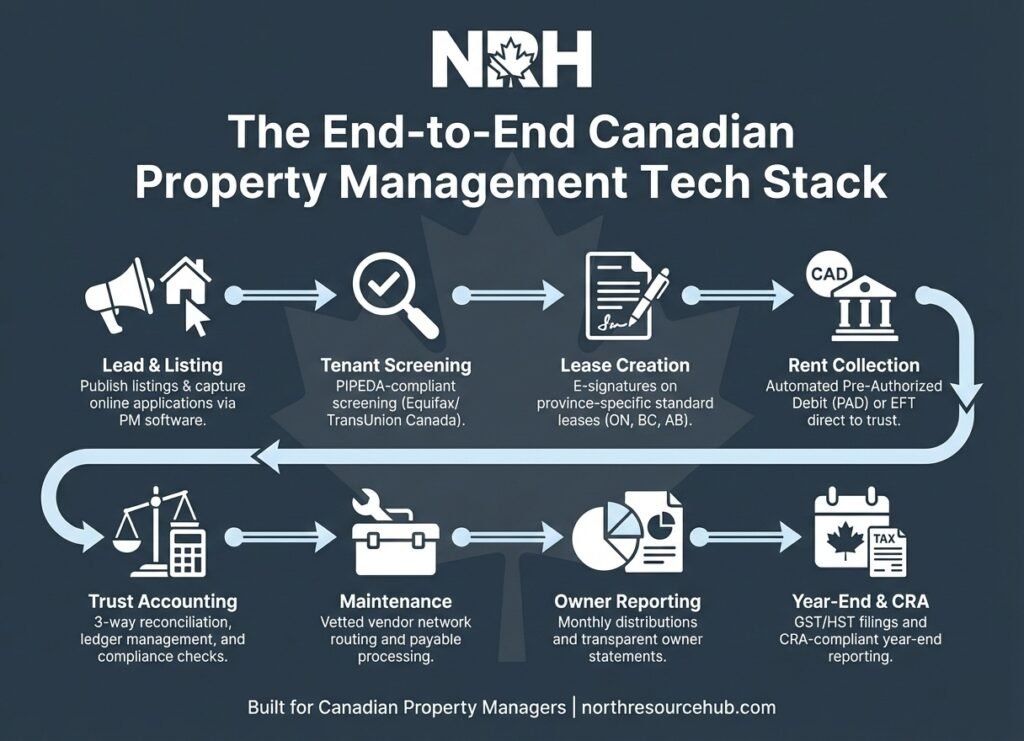
One of the more useful things a guide like this can do is show you what a properly integrated Canadian property management operation actually looks like from beginning to end. Not in theory — in practice, stage by stage, from the first lead to the final owner payout.
Here’s the full workflow, and where each tool or partner fits:
Stage 1 — Lead Generation & Listing Your property management software (MIPP or equivalent) publishes listings. Prospective tenants submit applications online through the platform.
Stage 2 — Tenant Screening Applications screened using a Canadian-compliant provider: credit check through Equifax Canada or TransUnion Canada, income verification, rental history, identity confirmation. Data collection governed by PIPEDA consent procedures from the start.
Stage 3 — Lease Creation Province-specific lease form generated within your software — Ontario standard lease, BC RTB form, or Alberta standard. E-signature completed digitally. Lease stored in the platform with full documentation trail.
Stage 4 — Rent Collection Pre-Authorized Debit or EFT rent collection activated. Payments flow into the trust account, automatically reconciled to the tenant ledger.
Stage 5 — Trust Accounting & Bookkeeping Your accounting partner (GAP, in NRH’s ecosystem) works inside your property management platform daily — processing transactions, managing trust ledgers, handling accounts payable, tracking vendor invoices. Three-way reconciliation completed monthly.
Stage 6 — Maintenance & Vendor Management Maintenance requests submitted through the tenant portal. Work orders routed to vetted vendors. Vendor invoices received, approved, and processed through the trust accounting workflow.
Stage 7 — Owner Reporting & Distribution Monthly owner statements generated — rent collected, expenses paid, management fees deducted, net distribution. Owner distributions disbursed from trust after reconciliation is confirmed. Reports aligned with CRA requirements for year-end.
Stage 8 — Year-End & CRA Reporting Accounting partner prepares documentation for CRA reporting. GST/HST filings supported. Year-end statements prepared for owners.
This is what a clean, integrated Canadian property management operation looks like. Each stage feeds the next. No manual workarounds. No compliance gaps. Nothing falling through the cracks between disconnected systems.
8. A Centralized Resource Built for Canadian Property Managers
North Resource Hub was built to close the gap between Canadian property managers and the Canada-specific resources that actually serve them.
It’s not a software platform, a lead marketplace, or a paid directory. Every partner featured on NRH goes through an evaluation process before being listed — assessed for direct experience with Canadian property management operations, understanding of provincial compliance requirements, transparent pricing, and consistent service delivery.
We’ve said it before and it’s worth repeating: this guide is written by the NRH team. Partner recommendations reflect our vetted ecosystem. We’ve tried to give you a balanced picture — which means acknowledging where partners have limitations, not just where they excel. You can make your own call.
Property managers can explore partners across software, accounting, tenant screening, and operational support, and book free consultations directly — no contracts, no lock-ins, no obligation.
→ Explore All NRH Partners
9. Questions Every Canadian Property Manager Should Ask Before Choosing Any Partner
These aren’t generic due diligence questions. They’re the specific things that reveal whether a vendor actually understands the Canadian property management context — or is just saying they do.
For Property Management Software
- Is this platform built for Canadian compliance, or adapted for it after the fact?
- How does it specifically handle trust accounting reconciliation for my province?
- Which Canadian banks and payment systems integrate natively — and which don’t?
- Does it include province-specific lease forms for Ontario, BC, or Alberta — or do I customize them myself?
- How is the platform preparing for the CPPA transition?
For Accounting and Finance Partners
- Do you specialize in property management trust accounting, or is real estate one of many industries you serve?
- How do you handle backlog cleanup and historical reconciliation — and what does that timeline typically look like?
- Do you work inside my existing property management software, or do you run a parallel system?
- Are you familiar with CRA reporting requirements specific to property management operations?
- How is your team structured — single bookkeeper or team-based with backup coverage?
For Tenant Screening Providers
- How do you ensure PIPEDA compliance throughout the screening process — specifically, not generally?
- Which Canadian credit bureaus do you access for credit checks?
- How is tenant data stored, protected, and eventually disposed of?
- Are your processes compliant with BC’s PIPA for operations in British Columbia?
- How are you preparing for the CPPA coming into force?
For Operational Vendors
- Are you licensed and insured in this specific province — not just nationally?
- What is your average emergency response time in this specific market?
- Do you provide digital documentation and reporting for property management records?
- What’s your process when a work order exceeds the originally quoted scope?
10. The Future of Property Management in Canada — 2026 and Beyond
Property management is among the fastest-growing real estate service lines in Canada, driven by the institutionalization of rental portfolios and rising demand for professional management across both residential and commercial assets.
Calgary continues to lead among the markets to watch. Toronto, Vancouver, and Halifax are each moving through their own dynamics. What they have in common is this: local compliance knowledge and market-specific vendor relationships are becoming more valuable as the industry matures and professionalizes, not less.
Three things will separate the strongest property management operations over the next three years:
Technology alignment. Platforms built for Canadian compliance will increasingly differentiate operators who scale cleanly from those who accumulate compliance debt quietly over time. The cost of cleaning up five years of US-adapted software workarounds is substantial — and it grows.
Accounting infrastructure. Trust accounting is where regulatory risk concentrates. Property managers who invest in specialized accounting support before a compliance problem surfaces protect their licences, their client relationships, and their capacity to grow. Waiting until something goes wrong is a more expensive approach than it looks.
Privacy compliance readiness. The CPPA transition will raise the bar for data handling across tenant screening, lease documentation, and owner reporting. Property managers building compliant processes now will navigate that transition with minimal disruption. Those who haven’t will face a much steeper adjustment.
The Canadian property management industry is professionalizing faster than most people in it realize. The operators building precision into their operations today will be the ones setting the standard in three years.
Frequently Asked Questions
Canadian property managers use a range of platforms. US-built options like Buildium, AppFolio, and Yardi are widely used but require meaningful customization for Canadian compliance.
Canadian-built platforms like Mi Property Portal are designed specifically for the Canadian market — provincial lease forms, GST/HST support, and Canadian payment infrastructure built in from the start.
The right choice depends on portfolio size, property type, provincial compliance needs, and trust accounting requirements. What matters most isn't the brand — it's whether the platform was built for Canadian compliance or adapted for it as an afterthought.
Buildium is a capable platform built primarily for the US market. Canadian property managers using it often need to customize trust accounting workflows, lease templates, and financial reporting to meet Canadian provincial compliance requirements.
Canada-built alternatives may offer better out-of-the-box compliance for Canadian operations, particularly around trust accounting and provincial lease documentation.
Trust accounting is mandatory for licensed property managers in most Canadian provinces when they hold client funds such as rent or deposits. Regulators like Real Estate Council of Ontario and Real Estate Council of Alberta require segregated trust accounts, monthly reconciliations, and audit-ready records. Non-compliance can result in penalties, audits, or licence suspension.
In most provinces where property managers are licensed and hold client funds in trust, yes. Requirements vary by provincial regulator — including RECO in Ontario and RECA in Alberta. Non-compliance can result in regulatory penalties, audits, and licence suspension. Specialized property management accounting support is strongly advisable for any property manager holding trust funds.
Legal tenant screening in Canada requires consent-based data collection under Personal Information Protection and Electronic Documents Act. Screening typically includes Canadian credit bureau checks, income verification, rental history, and secure data storage. Using US-only screening tools that ignore Canadian privacy law creates compliance risk.
Tenant screening in Canada must comply with PIPEDA federally and provincial privacy legislation such as BC's PIPA.
Legal screening includes credit checks through Canadian credit bureaus, identity verification, employment confirmation, and rental history verification — all conducted within applicable Canadian privacy law.
US-based screening tools that do not account for these frameworks introduce compliance risk.
The Consumer Privacy Protection Act is Canada's replacement for PIPEDA, introduced under Bill C-27. It brings stronger consent requirements, expanded individual rights over personal data, and new organizational accountability obligations. As of early 2026, it was moving through the Senate.
Property managers should monitor implementation timelines through the Office of the Privacy Commissioner of Canada and start reviewing their screening and data handling practices now rather than waiting.
Use curated, Canada-specific resources or referral networks rather than generic online directories.
Vendors should be verified for provincial licensing and insurance, regional experience, and familiarity with Canadian building codes and property management standards.
Building those vendor relationships before you need them urgently is one of the highest-value investments a property manager can make — and most don't do it until they're in the middle of an emergency.
North Resource Hub is a curated partner discovery platform for Canadian property managers and landlords.
Every partner goes through an evaluation process before being listed — assessed for Canadian market experience, compliance knowledge, and service quality.
Property managers can book free consultations with vetted partners across software, accounting, tenant screening, and operational support, with no contracts, no lock-ins, and no obligation. This guide is written and published by the NRH team.
Pingback: Trust Accounting for Canadian Property Managers 2026
Pingback: Tenant Screening Canada: The 2026 Legal Guide for PMs